Chapter Zero Slovenia
Family Business Transition Begins Long Before Leadership Changes

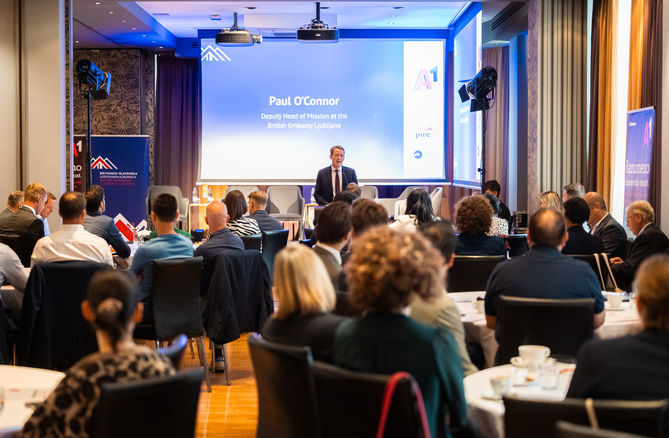
Ljubljana, 26 February 2026 – Questions of succession, ownership structure, and future growth are on the agenda of many Slovenian family businesses. Today’s Tea with Reason at Hotel Slon showed that families can define their next phase of growth with clarity and intention. Succession was framed not as a single handover moment, but as a structured and gradual process that begins long before leadership formally changes. Whether families are planning generational transfer, considering new partners, pursuing M&A, or assessing capital market options, early planning, honest dialogue, and clear governance remain essential to protect both legacy and long-term direction.
Opening the event, Luka Vesnaver, Chairman of the BSCC and Managing Partner at ION Advisory, stressed that decisions about succession, sale, partnership, or public listing are never purely financial but also personal. Such choices, he noted, have implications not only for owners but also for employees and even the community. Understanding what a potential investor truly brings to the business and aligning that with long-term strategy is essential when considering M&A or ownership change.
The central part of the event was a panel discussion, moderated by Jože Stare, Senior Associate at Law Firm Rojs, Peljhan, Prelesnik & Partners. Panelists talked about the key dilemmas family businesses face when planning their future, enriched by reflections from established companies that have already gone through generational transition.
Offering a UK perspective, Dr Allan Discua Cruz, Director of the Centre for Family Business at Lancaster University Management School, described succession as a gradual journey rather than a moment prompted by illness or retirement. It begins well before any formal handover and depends on the real interest of the next generation to take over and the willingness of the current generation to transfer responsibility, a dynamic he described as a key distinction between family and non-family businesses. With more than five million family businesses operating in the UK, they are important engine of the national economy and warned that poorly managed transitions can jeopardise not only the business, but also the employees that depend on it.
Experiences shared by Slovenian family businesses confirmed that successful succession rarely happens overnight. At Lotrič Meroslovje, the transition process began years in advance. CEO Maja Brelih Lotrič explained that the family deliberately opened conversations early and engaged external partners to help structure the shift to the next generation. When taking over SRC, Miha Žerko, President of the Management Board, viewed succession not as the replacement of a single individual at the top, but as the responsibility to build a trusted team that shares the same values and long-term vision.
At Labena Group, the transition was a big decision for the entire family. Founder and Owner Irena Lemut Čeh, who handed the business over to the next generation, described it as something the family has devoted immense effort and energy to over the years. As a result, she said, it truly feels like a family, united in its commitment and devotion to the company and its success.
From a legal standpoint, Bojan Šporar, Managing Partner at Law Firm Rojs, Peljhan, Prelesnik & Partners, pointed out noted that succession is not always straightforward, as not every family has a willing or suitable successor. In such situations, families may need to address the question of who will run the business and bring in external leadership. The transition takes time and should be thought through carefully.
Shifting focus to capital markets, Ivan Kovačev, Director of the Investment Banking Department at InterCapital, referred to Croatia’s recent wave of IPOs and outlined what is required to go public. In his view, listing is a viable option for companies that are leaders in their industry, reach sufficient size and valuation, and are prepared for increased transparency and regulatory obligations. He stressed that an IPO should not be treated as an alternative to exit or a way to maximise short-term financial gain, but as part of a long-term growth and succession strategy.
Slovenia, however, faces structural constraints when it comes to capital markets. Luka Vesnaver noted that, unlike Croatia, Slovenia has not undergone a comparable pension reform that would create a stronger domestic pool of institutional capital, limiting liquidity and investor depth. At the same time, he stressed that regardless of market conditions, successful transactions depend on thorough preparation and a clear separation between ownership and management.
For owners considering a sale or partnership, that preparation begins long before negotiations start. Andrej Fajfar, Managing Partner at Aeon Digital Group, advised defining primary objectives early and remaining realistic about valuation. He recommended seeking more than one advisory perspective to avoid hearing only what one wants to hear, and cautioned against overpromising during negotiations. A successful transaction, he concluded, needs clarity about the type of partner sought and a realistic understanding of which goals are essential and which compromises are acceptable.
The conference was organised in partnership with ION Advisory, Law Firm Rojs, Peljhan, Prelesnik & Partners, and SRC.
Photo gallery is available here.