Chapter Zero Slovenia
Strong Office Demand and Brownfield Regeneration Are Driving Ljubljana’s Urban Growth
Ljubljana, 14 May 2026 – Ljubljana’s commercial real estate market is marked by strong demand for modern office space, limited prime supply, and growing interest from institutional investors, while a significant wave of premium new offices is entering the market. This is accelerating the redevelopment of former industrial and underused areas into mixed-use districts, where offices are being viewed as part of wider urban environments with services, hospitality, public space, mobility, and quality of life. The success of these projects will depend on how well the city aligns private-public cooperation, spatial planning, infrastructure, and financing, and on whether new offices can offer what companies now look for in practice: flexible, sustainable, well-connected workplaces with services and amenities for their employees.
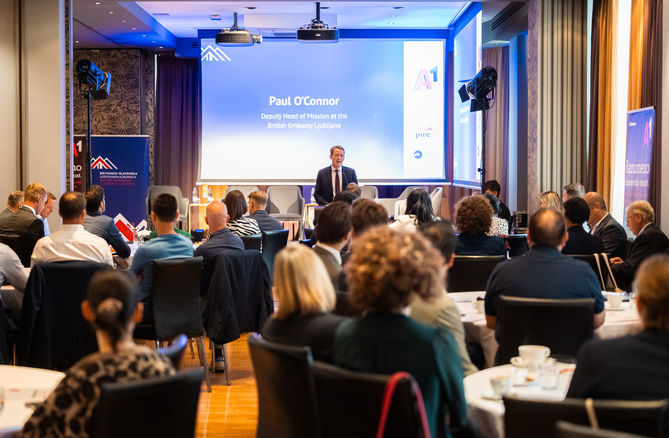
Opening the conference, Luka Vesnaver, Chairman of the British-Slovenian Chamber of Commerce, stressed that Ljubljana’s commercial real estate market is “no longer just about office buildings, but about creating cohesive environments where people work, live, meet, shop and spend time. The city is becoming part of a wider European shift where successful cities increasingly compete through quality of life, connectivity and attractive urban ecosystems.”
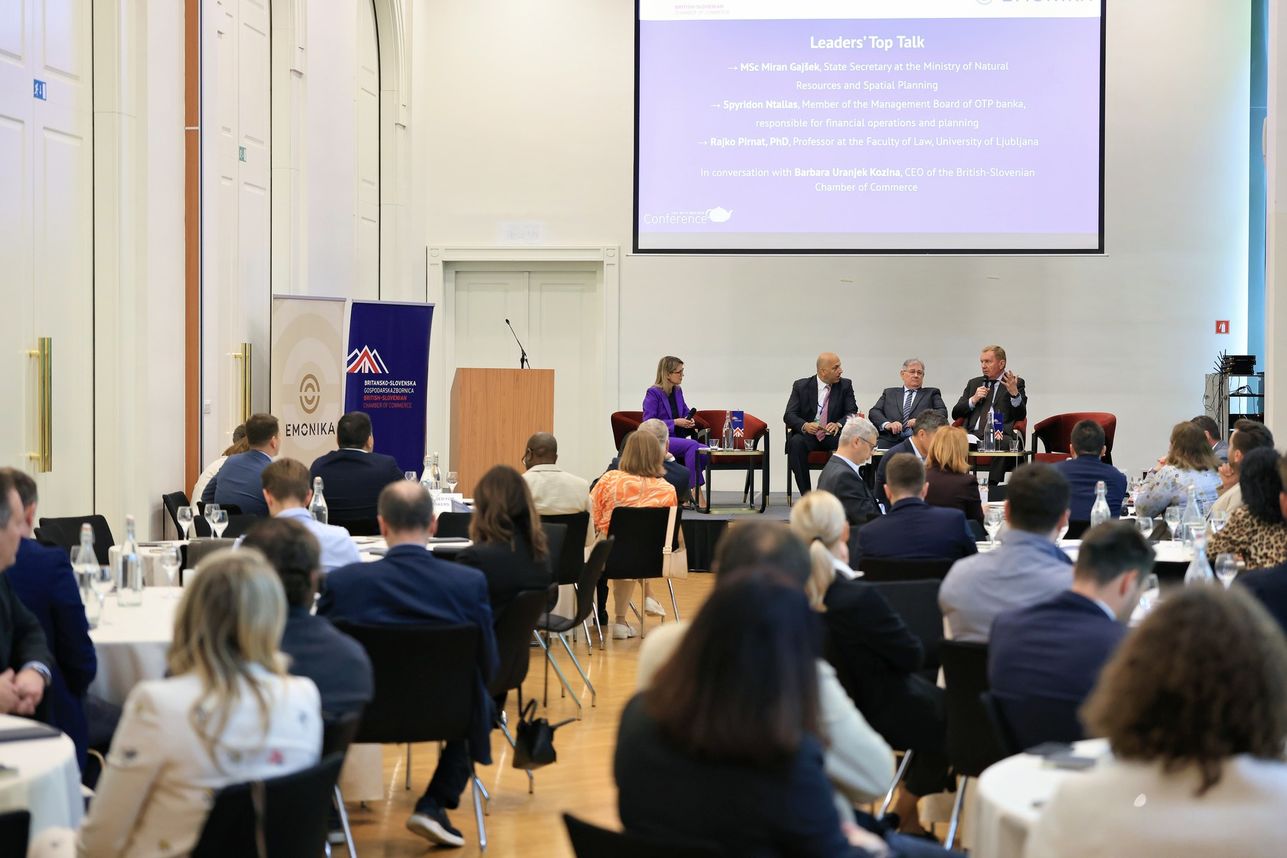
The strategic context was set during a Leaders’ Top Talk moderated by Barbara Uranjek Kozina, CEO of the British-Slovenian Chamber of Commerce. Better coordination between the state, municipalities, investors, architects, and the legal profession, alongside more efficient and predictable spatial-planning procedures, are the key prerequisites for successful urban growth. MSc Miran Gajšek, State Secretary at the Ministry of Natural Resources and Spatial Planning, pointed to recent government efforts to streamline spatial-planning procedures and accelerate development processes. He described Ljubljana as a strong example of collaboration between the municipality, the state, and private investors, where the development circle is well in place.
On the current market cycle, which requires disciplined investment and long-term thinking, spoke Spyridon Ntallas, Member of the Management Board of OTP banka, responsible for financial operations and planning: “Ljubljana’s commercial real estate market is clearly entering a phase of renewed growth, driven by strong demand and limited prime supply. This highlights the importance of disciplined financing and long-term, sustainable investment frameworks. He added that “financial institutions play a key role in supporting projects that combine quality locations, urban regeneration, and resilient cash flows, while ensuring prudent risk management across the development cycle.” A legal perspective on planning frameworks, predictability, and the complexity of urban transformation was offered by Rajko Pirnat, PhD, Professor at the Faculty of Law, University of Ljubljana.
The conference then turned to the role of brownfield regeneration and underused locations in creating new business districts across Ljubljana in a panel moderated by Vesna Ložak Polanec, Senior Associate at Law Firm Ketler & Partners, Member of Karanovic.
Ljubljana’s position compared with more mature European markets is becoming increasingly relevant for institutional investors. Andrej Erjavec, Board Member at InterCapital Real Estate, overseeing Fund Alfa, pointed to the city’s strong investment fundamentals: “Ljubljana offers institutional investors a compelling proposition: prime commercial real estate delivers a rental premium of at least 2-3% above senior bank financing costs, in a market with strong macro fundamentals that remains underpriced relative to core Europe.” He added that a significant wave of premium new office space is entering the market, and that investors will be watching closely how this supply is absorbed given Ljubljana’s size. At the same time, new institutional funds entering the market should bring greater liquidity for prime commercial real estate.
Looking at Ljubljana’s development pipeline, Pál Forgács, Managing Director of Mendota Invest, described brownfield redevelopment as one of the key ways to support the city’s continued growth: “At Mendota Invest, we see strong potential in converting brownfield sites into modern, mixed-use districts where offices, services, and public space are fully integrated. He pointed to projects such as Emonika, with its significant office component, as examples of developments that show “how brownfield redevelopment can unlock new business districts and redefine the city’s commercial geography.”
The panel also addressed how planning, infrastructure, sustainability, and execution determine whether regeneration projects can become long-term investment and employment destinations. Additional perspectives were contributed by Saša Galonja, Head of Spatial Planning and Construction Division at the Ministry of Natural Resources and Spatial Planning, Prof Dr Alenka Temeljotov Salaj, Professor of Sustainable Refurbishment and Facility Management at the Norwegian University of Science and Technology, and Janko Žnidaršič, CEO of REED Group.
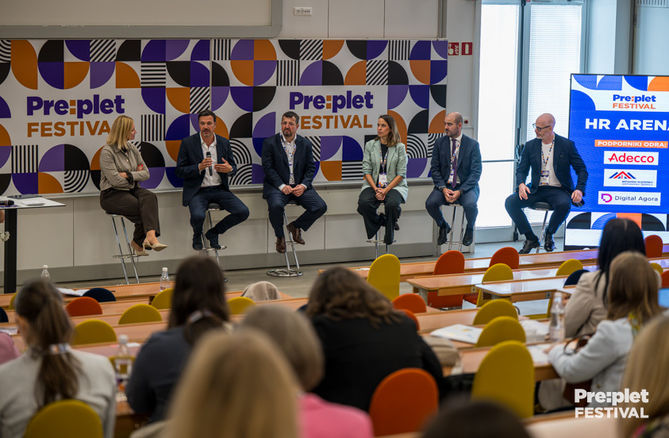
The final panel, moderated by Mark Vidrih, Consultant at Pristop, shifted the focus to the user perspective. The discussion explored how companies choose locations today, what defines office quality in a post-hybrid environment, and why modern workplaces increasingly create value only when they are integrated into mixed-use surroundings.
From a tenant perspective, Jana Petek, Global Head Real Estate Europe, MEA, Latin America and Canada at Novartis, stressed that offices must now support far more than basic functionality: “The office is no longer just a place where people sit. It creates value when it supports company strategy, reflects how people actually work and can adapt as business needs change.” In her view, quality workplaces should “also support collaboration, employee wellbeing, sustainability goals and a better experience for both employees and customers.”
According to Dóra Kenéz, Board Member of OTP Real Estate Fund Management, office buildings are increasingly perceived in the context of the surrounding urban environment: “Offices are increasingly evaluated as part of integrated mixed-use districts, where residential, retail, hospitality, and services collectively determine the quality and long-term attractiveness of a location. The key is understanding how occupiers make location decisions today, what defines quality in operational and spatial terms, and why certain mixed-use developments demonstrate stronger and more resilient performance over time.”
Drawing on the experience with large-scale regeneration projects, Wasya Awori, Director of Sales and House Development at Riko, reflected on the transformation of the Lakes by YOO in the United Kingdom. The project, he noted, “created more than 150 luxury homes and went far beyond constructing houses. It revitalised a once-neglected gravel pit, turning it into a vibrant natural retreat for families. At the same time, it reimagined the modern workspace for more than 120 employees, demonstrating how thoughtful design can foster both community and productivity.”
The discussion also included perspectives from Matic Kermavnar, Country Head Slovenia at CBRE, and Matej Rigelnik, CEO of Equinox Real Estate, who addressed Ljubljana’s growing need for modern Class A office space, the role of adaptive reuse, and the increasing importance of amenities, services, and user experience in determining which locations remain competitive.
A special thank you goes to the Main Partner of the conference – Emonika.
The photo gallery is available here.
Photo: Borut Cvetko (Mediaspeed)